Photo Gallery
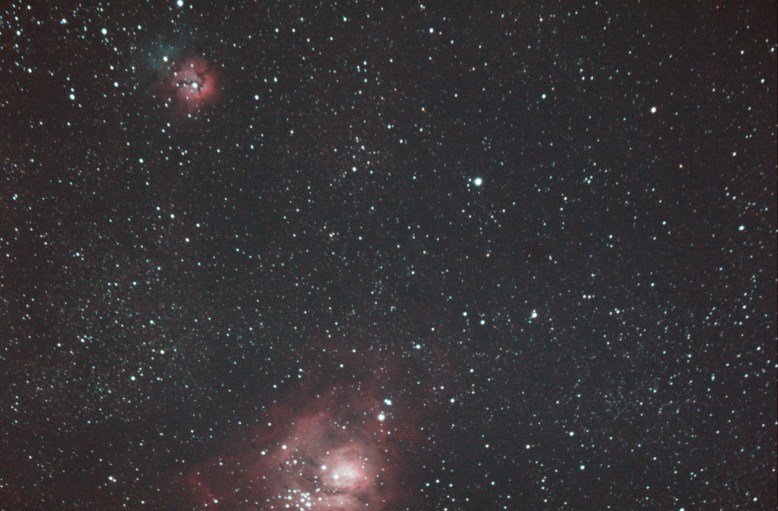 M8 and M20: The Lagoon and Trifid Nebulae
This image taken with my Explore Scientific ED80 contains two photogenic nebulae. In the top left is the blue and red Trifid Nebula, and at the bottom of the image is the larger Lagoon Nebula. Both nebulae are thought to reside around 5000 light-years away, and are regions of star formation. They are located in the constellation Sagittarius. The field of view of the image is a little less than two degrees, or about four full moons across. This image was taken from on top of the science building at Woodberry Forest School.
Image Details
This image is a stack of 8 individual 45-second exposures. Calibration was also performed using 30 dark frames and 50 bias frames. It was captured using BackyardEOS, stacked in DeepSkyStacker, and processed in Adobe Photoshop.
Link to full-sized image: http://imgur.com/a/TTVZK
_________________________________________________________________
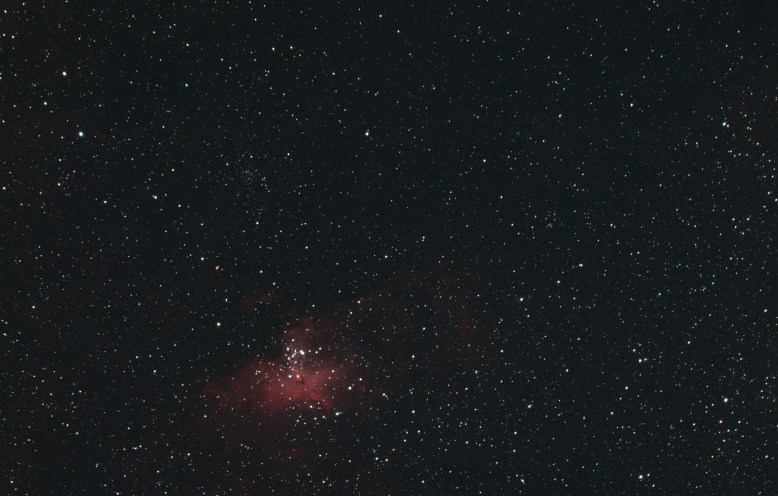 M16: The Eagle Nebula
This wide field image contains the Eagle Nebula, a star forming region in the direction of the constellation Serpens. The pillars in the center of the Eagle Nebula were made famous by an image from the Hubble Space Telescope dubbed the “Pillars of Creation.” I am excited to have captured this famous region, which is located about 7000 light-years away. Although the pillars appear tiny in this image, they are actually light-years long and are made up of dense molecular hydrogen and dust. This image was taken from on top of the science building at Woodberry Forest School.
Image Details
This image is a stack of 88 one-minute exposures, calibrated in DeepSkyStacker with 30 dark frames, 50 flat frames, 20 dark flat frames, and 50 bias frames. It was processed in Adobe Photoshop.
Link to full-sized image: http://imgur.com/a/TTVZK
_________________________________________________________________
M51: The Whirlpool Galaxy
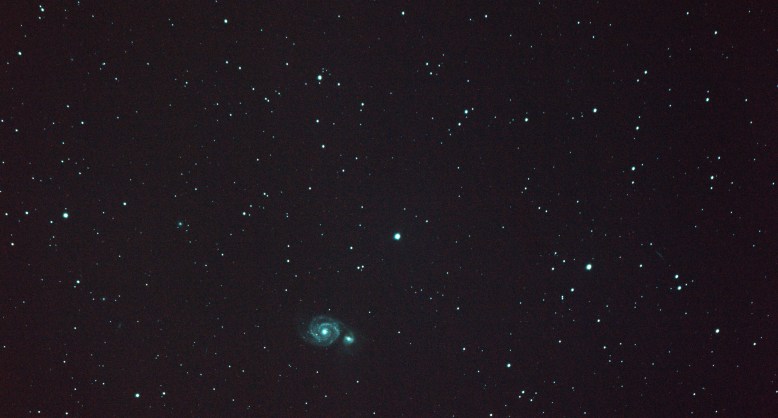
This image contains the Whirlpool Galaxy, a spiral galaxy located about 30 million light-years away towards the constellation Canes Venatici. The Whirlpool Galaxy itself is fully 60,000 light-years across, and is engaged in a gravitational tug-of-war with its smaller companion galaxy, NGC 5195. This image was taken from Flattop Mountain outside of the Blue Ridge Observatory.
Image Details
This image is a stack of 90 one-minute exposures, calibrated with dark frames in DeepSkyStacker and processed in Adobe Photoshop.
_________________________________________________________________
M13: Globular Cluster in Hercules
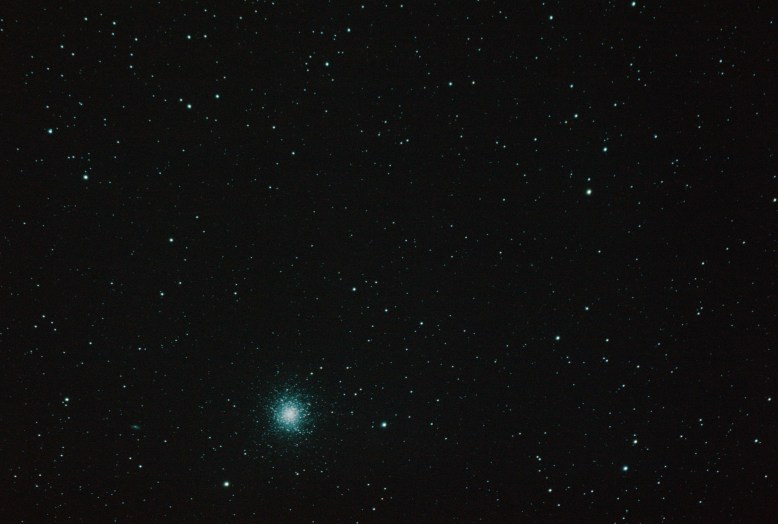
In this image is the Great Globular Cluster in constellation Hercules, M13. It is a cluster of about 300,000 stars that are all located about 25,000 light-years from Earth. The entire cluster is about 145 light-years in diameter. This image was taken from Flattop Mountain outside of the Blue Ridge Observatory.
Image Details
This image is a stack of 50 one-minute exposures, calibrated with dark frames in DeepSkyStacker and processed in Adobe Photoshop.
_________________________________________________________________
M52: Open Cluster in Cassiopeia
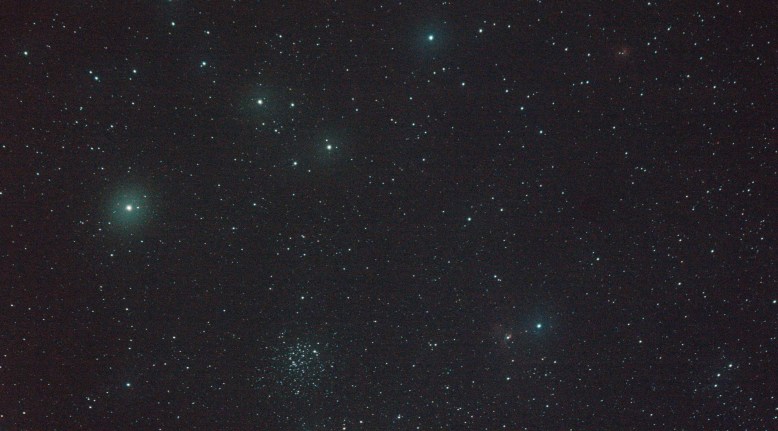
This wide-field image of an area of sky near the constellation Cassiopeia contains several interesting objects, the primary being the open cluster M52, which is located slightly left of and below the center of the frame. To the right of the open cluster is the faint red Bubble Nebula, also known as NGC 7635. Also prominent in this image are several bright stars. This image was taken from Flattop Mountain outside of the Blue Ridge Observatory.
Image Details
This image is a stack of 50 one-minute exposures, calibrated with dark frames in DeepSkyStacker and processed in Adobe Photoshop.
 Dw Astrophotography