It is currently May 10, and I am just past the halfway point in the five week period of my project. The first two nights (April 23 and 24)  I had clear skies and was able to stay out all night on the observation deck of the science building at school. On the first night, I worked on finalizing my set-up and practicing how to get the computerized mount properly aligned. The second night, after a lot of struggling and many failed attempts, I finally got a successful polar alignment, which means that I aligned the polar axis of the mount with the celestial pole so that the motor could move the mount at a precise speed, called the sidereal rate, in order to track the motion of the stars across the sky. This was my first polar alignment, and it wasn’t perfect. I didn’t have a polar finder scope, so I used a green laser to align the polar axis of the mount with the star Polaris, which is close to the celestial pole.
After successfully aligning the mount, I tested that it was able to slew to different named stars and track their movement across the sky. From my visual 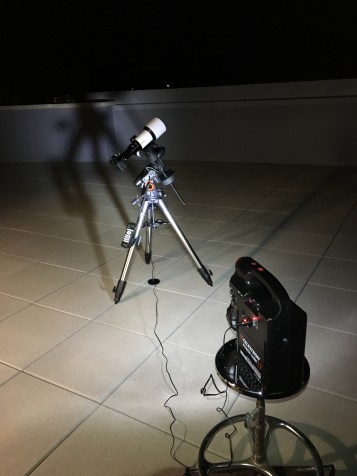 perspective, the tracking was excellent. Since the tracking was working, I decided to hook up the camera and try some imaging. First, I decided to try to image M101, the Pinwheel Galaxy, which is located in the constellation Ursa Major. After slewing to M101 using the computerized database in the hand controller, I took some test exposures to determine if the galaxy was in the field of view. With exposures of around 3 minutes, I was able to see that it was in fact in the field of view. Without an auto-guiding system, however, a 3 minute exposure produced noticeable star trailing and was thus too long. After testing several different exposure lengths, I determined that a 90 second exposure was possible because I couldn’t detect star trailing in the camera’s playback screen. I then began imaging M101 for the next hour or so. I also collected dark frames after the lights.
Afterwards, I attempted to image the Lagoon Nebula, M8, an emission nebula located in the constellation Sagittarius. After slewing using the hand controller’s database and determining that it was in the field of view, I took 90 second exposures. Around 4:45 A.M., the sky began to brighten, and I decided to stop imaging for the night. I was unable to take more dark frames because the camera battery was low and I did not have an extra battery.
I have since examined the pictures of M101 and M8. At the time I took them, I was having a problem with the program Deep Sky Stacker, an astronomical program used for the calibration of images with lights, darks, flats, dark flats, and bias images. I was however able to mess around with the individual frames in Photoshop a bit, and I could tell that there was a considerable amount of nebulosity in M8. I could also tell that 90 seconds was too long for the tracking accuracy of the mount without auto-guiding, as there was star trailing in the individual exposures. I have since fixed the problem with Deep Sky Stacker, but have not yet re-tried the images from this night. I hope to re-examine these images and get some better exposures of M8.
 Dw Astrophotography