On Sunday, May 8, Mr. Nolan LaVoie, Mr. Erik Born and I traveled to Blue Ridge Observatory on Flattop Mountain near Dyke, Virginia. Blue Ridge Observatory is 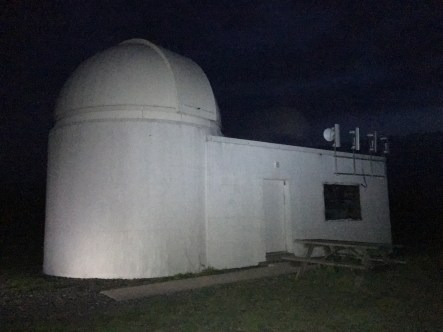 a private observatory owned by Mr. Dean Wilder, who is a member of the Charlottesville Astronomical Society. Mr. Wilder was kind enough to show us around his observatory and let me set up my equipment on his property.
Inside his observatory, he had a 16-inch Ritchey–Chrétien telescope permanently mounted on a Paramount mount. It was one of the most awesome telescopes I’ve ever seen in person. The observatory also had a warm room with a com

Mr. Wilder’s 16-inch Ritchey-Chrétien Telescope
puter to control the telescope, and examples of Mr. Wilder’s astrophotography on the wall, including a beautiful picture of the Horsehead Nebula. Unfortunately, the observatory roof was in the process of being repaired, and we were unable to use his telescope, but I set up my equipment outside for a night of imaging.
From the position I set up my equipment outside of the observatory, I had an excellent view overhead and towards the east. I again used a laser to align the polar axis of the mount with the star Polaris and aligned the computerized mount with six named stars.
For imaging this time, I used the program BackyardEOS on my laptop to control the camera, which was extremely useful. I was able to display images immediately on the computer screen for examination, control all camera settings, and use the program to precisely focus the telescope based essentially on the width of a certain star, called the Full-Width Half-Maximum value.
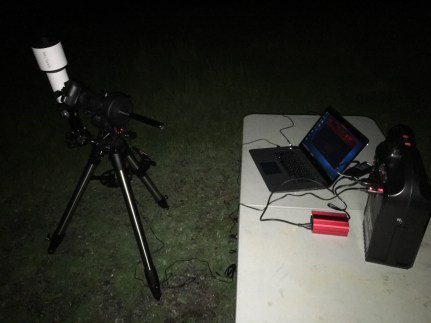
My set-up in the field
I had decided that my primary target for the night was going to be the Lagoon Nebula, M8, but I knew that it would be low on the horizon until later in the night. I decided to try imaging M51, a spiral galaxy in the Constellation Canes Venatici known as the Whirlpool Galaxy, before M8 was at a better position in the sky. Fortunately, Mr. Wilder suggested that I start with an easier target to make sure everything was working properly. I took his advice and started with M13, known as the Great Globular Cluster in Hercules. I took several 60 second exposures of M13 and was very impressed with the way they came out on the computer screen.
After determining that everything was working properly, I switched to imaging M51. I was also very impressed with the way these images were coming out as well. I could clearly see the galaxy with a 60 second exposure at ISO 3200. I ended up taking 60 second exposures at ISO 1600 because the noise level was too high at ISO 3200. Throughout the night, clouds rolled in and out, sometimes obscuring the galaxy. I continued to image M51 for most of the night and collected dark and bias frames when the clouds were present. Unfortunately, the Lagoon Nebula was covered by clouds for the entire night, so I didn’t get to image it. I did however get some images of the open cluster M52 during the later part of the night.
It was a very successful trip to an awesome place, and I can’t thank Mr. Wilder enough for letting us set up at his observatory. I collected tons of data that I am now working on processing. Hopefully I’ll have some finished images to share soon.
 I had clear skies and was able to stay out all night on the observation deck of the science building at school. On the first night, I worked on finalizing my set-up and practicing how to get the computerized mount properly aligned. The second night, after a lot of struggling and many failed attempts, I finally got a successful polar alignment, which means that I aligned the polar axis of the mount with the celestial pole so that the motor could move the mount at a precise speed, called the sidereal rate, in order to track the motion of the stars across the sky. This was my first polar alignment, and it wasn’t perfect. I didn’t have a polar finder scope, so I used a green laser to align the polar axis of the mount with the star Polaris, which is close to the celestial pole.
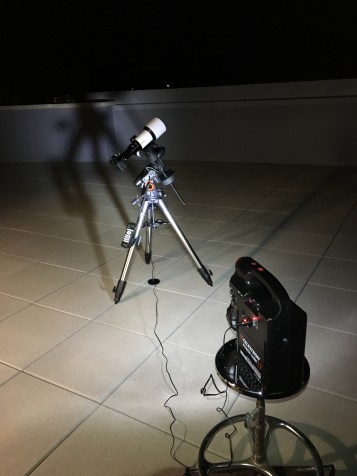 perspective, the tracking was excellent. Since the tracking was working, I decided to hook up the camera and try some imaging. First, I decided to try to image M101, the Pinwheel Galaxy, which is located in the constellation Ursa Major. After slewing to M101 using the computerized database in the hand controller, I took some test exposures to determine if the galaxy was in the field of view. With exposures of around 3 minutes, I was able to see that it was in fact in the field of view. Without an auto-guiding system, however, a 3 minute exposure produced noticeable star trailing and was thus too long. After testing several different exposure lengths, I determined that a 90 second exposure was possible because I couldn’t detect star trailing in the camera’s playback screen. I then began imaging M101 for the next hour or so. I also collected dark frames after the lights.
 Dw Astrophotography